
Equinox is one of the most interesting astronomical events, a balance point in Earth’s journey around the Sun every year. On 22nd September 2025, at 18:19 UTC, the September equinox arrives, which has special seasonal and cultural significance worldwide.
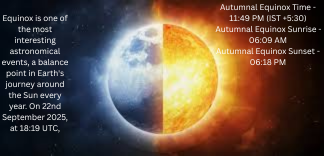
The word equinox comes from the Latin terms aequus (equal) and nox (night), which express the concept of virtually equal day and night. An equinox occurs twice a year, in March and September, when the Sun crosses the celestial equator. On these days, the Sun lies directly over the equator, making day and night approximately equal in duration over much of the Earth.
Astronomical Importance
The September equinox is the time when the Sun traverses southward over the celestial equator. In the Northern Hemisphere, it means the end of summer and the start of autumn. The temperatures slowly cool, days get shorter, and the nights are longer. On the other hand, in the Southern Hemisphere, the September equinox is the beginning of spring, longer days, and increased warmth and growth.
One of the impressive characteristics of the equinox is that the Sun rises precisely due east and sets precisely due west for nearly every place on Earth. It is thus a crucial reference point for both astronomy and navigation.
Cultural and Historical Significance
Throughout the history of humanity, equinoxes have been seen as milestones of the seasonal cycle. Ancient cultures, like the Mayans and Egyptians, constructed monuments aligned on the equinox Sun, utilizing it to monitor the agricultural seasons. Even now, numerous cultural and religious practices celebrate the equinox with harvest, balance, and renewal festivals. For example, in Japan is celebrated at this time to commemorate ancestors, while in Western cultures, the equinox tends to overlap with harvest festivals.
Science Behind Equal Day and Night
Even though the equinox is commonly imagined as the day day equals night, this is not quite accurate. Due to atmospheric refraction, sunlight bends around Earth’s atmosphere, allowing us to see the Sun even before it has physically risen and after it has set. As a result, daytime is usually a few minutes longer than night on the equinox. The exact day of true equality, known as the equilux, may fall a few days before or after the equinox depending on geographic location.
Global Impact
For humans everywhere, the equinox is not merely an astronomical phenomenon—it is a symbolic instant of equilibrium. In the Northern Hemisphere, it arrives at the beginning of a period of contemplation, planning, and harvest, while in the Southern Hemisphere, it is a season of rebirth and expansion. Astronomers, farmers, cultural groups, and outdoor enthusiasts alike share a glance to the equinox as an indicator of the immense interrelationship between Earth and Sun.
Timings
Conclusion
The September equinox on September 22nd, 2025 is a scientific landmark as well as a cultural signpost. It marks the equivalence of day and night, announces the turnover of the seasons, and reminds mankind of our communal journey beneath the Sun. As either a celestial phenomenon, a climatic threshold, or a cultural celebration, the equinox remains a source of wonder and contemplation, connecting the natural world to human cultures over space and through time.